I can taste roasted beans in every sip. The drink contains no sweetener. My friend says this drink is popular here.
 I drank mine at Gyerong Station, near Daejon:
 This tea hit the spot after a dehydrating weekend at the buddhist temple. I can taste roasted beans in every sip. The drink contains no sweetener. My friend says this drink is popular here. This tea hit the spot after a dehydrating weekend at the buddhist temple.
  I love the chewy rinds that lurk at the bottom of the glass. My friend wanted a sip. She has a jar of citron tea at home, but they use it on toast, not as tea!
 Peanuts with sweet, seaweed-infused sticks. I love the sweet-and-savory taste of Korean snack foods.
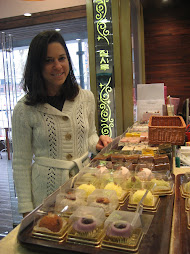
 On the other hand, I do not like the buttery, light nature of Korean cakes. Looks pretty, though!
 I loved the water machines with the paper cup dispensers:
 The "cup" was actually a two dimensional envelope that can be filled with water. Trouble is, I had to refill it ten times to satisfy myself!
  I tried a sugar one in the spirit of my Korean food blog. Of course I didn't care for the sweetness or aftertaste so I spit it in my napkin. (Unlike at Sancheon, where I simply returned a bitten kimchi fritter to the community bowl.)
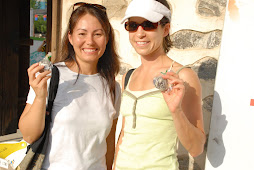
 (Photo courtesy of Studio Sans.)
 The second person plops a scoop of sweet red bean and nuts onto the strands. Then he uses a pair of chopsticks to spin the strands around the red bean. The finished product is a small, white stringy soft "candy" with a bean/nut center:
 If you're lucky, they'll give you a sample. If you're female, they'll probably demand that you eat it straight from their outstretched chopsticks!
  This baggie has been sitting in the back of my freezer for the past six months. Somehow I can not muster the courage to boil sticks in water. Maybe next time we go camping I'll give it a try. It seems like an outdoor activity.
  Speaking of tea, a new contractor stopped by my office. She gave me to packets of tea, which she had trouble describing in English. One is a green tea with brown rice (two of Korea's most popular ingredients) and the other is as yet unidentified:
  I've never been much of a tea drinker. It tastes bitter and leaves a film on my teeth. However, I actually enjoy the different Korean teas. It's fun to see how many products I can try with green tea!
 Here is mi-sook-gar-u (as spelled on the menu), a hearty drink of several grains. The consistency resembles that of a yogurt smoothie, but the taste is all grain.
 Shik-he, made with rice, crushed ice, and lots of sugar, was my mom's choice. It was very refreshing after a long day outdoors! Vendors also sell this drink on the street. A canned version is also available. Don't let the rice fool you, though: this drink is as healthy as soda. One serving contains more sugar than a regular Coke!
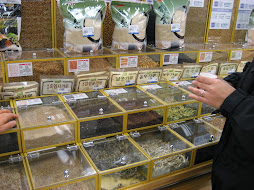
 Campbell's Soup for a whopping $2.00 a can.
 I wonder how many households serve pure maple syrup at $13-$14 per jar.
 You'd think these basic nuts were a delicacy at these prices!
 Plenty of choices for coffee and milk!
 Probiotic drinks - you choose the bacteria and the flavor!


Here is a beverage with a bacterial boost: L. acidophilus, S. thermophilus, Bifidobacteria, and L. casei to be exact. The bottle contains only 1/2 cup of peach-flavored drinkable yogurt. The consistency resembles that of milk, but the taste is 100% sweet & sour yogurt.
Like the Denmark candies, this drink's label does not give the quantity of bacteria. Based on my personal experience, however, it clearly contains enough bacteria to do something. Perhaps something delightful is happening inside my GI tract, but outside my body the effects are not so pleasant.
The bearded man on the label, Metchnikoff, is credited for suggesting that bacteria may have useful effects on the GI tract. He won a Nobel Peace Prize in 1906 for discovering phagocytosis, the process important to white blood cells. However, he did not actually study probiotics. Another scientist, a Japanese man named Minoru Shirota, took Metchnikoff's idea and spent his life creating a unique bacterium that could thrive in the GI tract.
In 1935 Shirota created a milk beverage called Yakult that contained his healthy bacterium. This drink is available worldwide. Korea's "Metchnikoff Life" must be a variation on the Yakult theme. It's no surprise, then, that the shelves contain so many probiotic beverages: they've been commonplace here for 73 years!