Showing posts with label Sweets. Show all posts

Sunday, February 15, 2009

Valentine's Day Chocolates

In Korea women give men chocolate for Valentine's Day. We watched the ritual several times while enjoying red drinks at the Seoul Hyatt. Our friend gave us chocolates too:One month later, on White Day, men return the gesture by giving candy to women.I guess my self-made holiday, Analog Holiday, is not really unique after all. On this day I treat my husband to his favorite "man" things. We celebrate it on January 14, one month before V-day. I'm not sure if he likes it as much as I like V-day!

Tuesday, January 20, 2009

Tteok Cafe Jilsiru

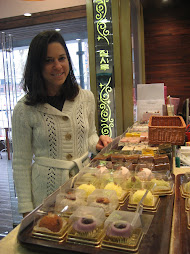
We had to try the rice cakes after visiting the museum. Each rice cake cost 1500W or about $1.10. So many choices! We drank persimmon leaf tea rich in vitamin C:The tea was disappointing. I could have prepared a cup at home with a leaf cutting!Potted herbs and lit, scented candles sat on each table. The place was quiet, even relaxing, a rarity for a Korean cafe.Our plate of rice cakes (from left to right) included dense black bean, dense pumpkin and seeds, green tea round, and citron acorn. The citron rice cake, our favorite, tasted like a fresh orange. I loved how the rice cakes were halved despite their small size.A sweet, green tea paste filled the green ball. I swear the powder is ground black bean and not dirt!

Would rice cakes have a place in America's 'Starbucked' culture?

Friday, December 19, 2008

Dream of Dark Chocolate

Chocolate lovers in Korea can describe their favorite chocolate down to the percentage of cocoa: For those of us looking for a health benefit to eating sweets, 72% cocoa is a healthy choice. The darker the better, since health-boosting flavonoids give chocolate its dark color. Also, look for cocoa butter as an ingredient rather than palm or coconut oil. Though cocoa butter contains saturated fat, its effect on blood cholesterol is neutral. This reputable website recommends no more than seven ounces per week.
I prefer supplements, fruits, vegetables, or certain teas for antioxidants. I'm not a choco-holic,though, so I could care less about chocolate. Nevertheless, I did buy the 72% chocolate, and it tasted fine. I'm still a lifelong vanilla fan, though!

Sunday, November 23, 2008

Fish Bread

Cold weather indicates the beginning of fishing season. By fishing, I mean finding a street vendor who sells pang ap bang. Pang ap bang literally means "bread without fish." The fish-shaped cooked dough is actually filled with sweet red bean, not fish paste. It costs 1000 won for three. (Less than a dollar these days, with a rate of 1401 won per dollar as of Nov 30.)

Too bad I missed out on these sweet treats last year. The fish shape scared me away!


Sunday, November 16, 2008

Rice Cake Gift Box

I received an unexpected gift at work from some Korean vendors:A box of Korean rice cakes or tteok!
Of course I sampled everything right away. I took a few bites of each one. Because the texture was gummy and dense, it was difficult to eat much more. The pale orange one tasted like fresh pumpkin, mildly sweetened. The second one tasted like rice seasoned with soy sauce. I did not care for it.
The third one looked unappetizing but tasted wonderful. Mashed black beans surrounded a tender, rice cake center. A few green peas added color and a mildly sweet flavor.


This multicolored, dense rice cake was bland and extremely gummy. I spit out my bite. Maybe it would be better with a sauce?

And, finally, my favorite cake: coconut covered sweet rice cake with red bean filling. Delicious!

Wednesday, September 17, 2008

Delimanjoo

The sweet smell of freshly baked Delimanjoo cakes tempts me every time I transfer Metro trains at Samgakchi Station. Usually, the smell alone satisfies me, but sometimes I buy a small sack of the custard-filled mini cakes. I'm disappointed when the vendor hands me a pre-made sack; the best cakes are fresh off the griddle. That way the outside is crisp while the inside is hot and tender. The cakes aren't too sweet, and they're never greasy. One sack has about 320 calories according to the bag.
A small bag contains about 12-15 cakes (about 100 grams) and costs $2. You can only buy them at bus stations or subways, places that usually quell my appetite. Sometimes if you stand next to the griddle and look confused, the vendor will give you a free sample.
My mom enjoyed this treat but liked hotteok best. As for me, I like them all in moderation!

Wednesday, September 10, 2008

Hotteok at Namdaemun Market

We spent a few hours purse-hunting at Namdaemun Market. For a snack, we tried the Korean street food, hotteok, for a mere fifty cents. The Chinese brought this sweet-filled, fried dough to Korea in the 19th century. Suprisingly, wheat, not rice, flour is the main ingredient. The filling typically consists of brown sugar and nuts. It tends be greasy, though some merchants sell a healthier, baked variety. The vendor folds the hotteok in half and serves it in a small paper cup. It usually takes 10 minutes for it to cool enough to eat. (I always grow impatient and burn my fingers.)
My friend purchased a hotteok baking mix. I am looking forward to a hotteok-making party!

Sunday, September 7, 2008

Tea House at Insa-dong

After touring Gyeongbokgung and Changdeokgung Palaces, we wanted to rest our feet. I took my mom and aunt to a tea house in Insa-dong, where we tried hwachae instead of Korean tea. Hwachae, or traditional cold beverages, are made with fruit or grains and water sweetened with sugar or omija (more on that fruit in a future post).
Here is mi-sook-gar-u (as spelled on the menu), a hearty drink of several grains. The consistency resembles that of a yogurt smoothie, but the taste is all grain.
Shik-he, made with rice, crushed ice, and lots of sugar, was my mom's choice. It was very refreshing after a long day outdoors! Vendors also sell this drink on the street. A canned version is also available. Don't let the rice fool you, though: this drink is as healthy as soda. One serving contains more sugar than a regular Coke!

Sunday, August 17, 2008

Famous Tea Place in Samcheondong

My friends and I stopped at this famous tea place after a hilly walk through Bukchon. I had been craving its traditional red bean juk ever since trying it with a Korean friend. Koreans call this dish a dessert, but it's a rich soup in my eyes. Juk literally means porridge, quite a dreadful-sounding word for such a tasty food! The menu offered two herbal Chinese teas ($5-$7 each), a ginger tea, a persimmon tea, a rice tea, and this porridge. As per Korean culture, we received one menu for the four of us.
The sweet, thick red bean base was topped with cinnamon, red beans, and chestnuts. A glutinous rice ball lurked beneath the surface. I can not think of an American food equivalent to the rice ball. It took me awhile to adjust to the gummy texture. I can't help but wonder if the globule is now bobbing around in my stomach.

Monday, August 4, 2008

Hello, Probiotic Candy!


The promise of probiotics and the reference to Denmark drew me to this candy. Originally I thought Korea exported the candy from Denmark. In reality, only the bacteria, the patented BB-12 Bifidobacterium, comes from Denmark. The candy company itself, Haitai, is Korean.


I keep writing "candy" to remind myself that these tasty chews are more candy than neutraceutical.


Probiotics are "friendly" bacteria that have a beneficial health effect on the GI tract. Many different bacterial strains are probiotics, and each one has a unique effect and dosage. Bifidobacteria, along with other species, are generally considered safe.


How much BB-12 is in each serving of candy? And how much needs to be consumed each day to have effects? And what are the effects, anyway? Unless these questions are answered, this product is simply candy with a gimmick.